Which of the Following Conclusions Can Be Drawn About Power in Relationships?
Charge Interactions
Mayhap you have heard it said so many times that it sounds like a platitude. These ii fundamental principles of charge interactions will be used throughout the unit to explain the vast array of static electricity phenomena. As mentioned in the previous section of Lesson 1, in that location are two types of electrically charged objects - those that contain more protons than electrons and are said to be positively charged and those that contain less protons than electrons and are said to be negatively charged. These two types of electrical charges - positive and negative - are said to be contrary types of charge. And consequent with our fundamental principle of charge interaction, a positively charged object will concenter a negatively charged object. Oppositely charged objects will exert an attractive influence upon each other. In contrast to the attractive force between two objects with reverse charges, 2 objects that are of similar accuse volition repel each other. That is, a positively charged object will exert a repulsive force upon a second positively charged object. This repulsive force will push button the two objects apart. Similarly, a negatively charged object will exert a repulsive force upon a second negatively charged object. Objects with like charge repel each other. This electric forcefulness exerted betwixt two oppositely charged objects or two like charged objects is a force in the same sense that friction, tension, gravity and air resistance are forces. And being a forcefulness, the same laws and principles that draw whatsoever strength describe the electric strength. Ane of those laws was Newton'due south law of activeness-reaction (discussed in Unit two of The Physics Classroom). According to Newton'southward tertiary law, a force is simply a mutual interaction between 2 objects that results in an Object A exerts a rightward button upon Object B. Object B exerts a leftward push upon Object A. Run into diagram at right. These 2 pushing forces have equal magnitudes and are exerted in contrary directions of each other. Each object does its own pushing upon the other. The push upon Object B (by Object A) is directed abroad from Object A; and the push upon Object A (by Object B) is directed abroad from Object B. Because of the abroad from nature of the common interaction, the force is said to be repulsive . The interaction between 2 like-charged objects is repulsive. The interaction between two oppositely charged objects is bonny. What type of interaction is observed between a charged object and a neutral object? The reply is quite surprising to many students of physics. Any charged object - whether positively charged or negatively charged - will accept an attractive interaction with a neutral object. Positively charged objects and neutral objects attract each other; and negatively charged objects and neutral objects attract each other. 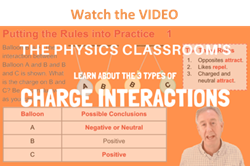 Suppose that you rubbed a balloon with a sample of brute fur such as a wool sweater or even your ain pilus. The balloon would likely become charged and its charge would exert a strange influence upon other objects in its vicinity. If some pocket-size bits of paper were placed upon a table and the balloon were brought near and held to a higher place the newspaper bits, then the presence of the charged balloon might create a sufficient attraction for the paper bits to heighten them off the table. This influence - known equally an electric force - occurs even when the charged balloon is held some altitude abroad from the newspaper bits. The electric force is a non-contact force. Any charged object can exert this force upon other objects - both charged and uncharged objects. One goal of this unit of The Physics Classroom is to sympathise the nature of the electric strength. In this part of Lesson one, two uncomplicated and fundamental statements will be made and explained virtually the nature of the electric forcefulness.
The Electric Force and Newton's 3rd Law


Interaction Between Charged and Neutral Objects

Flickr Physics Photo

Repulsion versus Attraction


The to a higher place thought experiments illustrate the conclusive nature of a repulsive interaction. When objects repel each other, one tin can be certain that both objects are charged. On the other had, the observation of an attractive interaction leads to limited conclusions. At best, ane tin conclude that at to the lowest degree i of the objects is charged.
We'll conclude this role of Lesson ane by request the question "How can a charged object and a neutral object attract?" Every bit y'all've read this page, you might take been thinking something like "But I've but heard of ii fundamental charge interactions - opposites concenter and likes repel. Where did this third charge interaction come from?"
In all likelihood, well-nigh of united states of america have only heard of two types of charge interactions (opposites attract and likes repel); and both of these accuse interactions are cardinal interactions. The 3rd argument - any charged object and a neutral object will attract each other - is just an observable fact that can exist explained past the two fundamental charge interactions. How? The caption of this 3rd accuse interaction volition be saved for the last page of Lesson 1. Merely first, the subject of conductors and insulators must exist explored in gild to understand our tertiary type of accuse interaction.
Flickr Physics Photograph
Two like-charged balloons hang from a common signal from the ceiling. The repulsion effects cause them to hang at an angle from their usual vertical alignment. A plastic tube is charged past rubbing with synthetic fur. The plastic tube is inserted into the space between the balloons, causing fifty-fifty further repulsion. 
We Would Like to Advise ...
 Sometimes information technology isn't enough to just read about information technology. Y'all have to collaborate with information technology! And that'south exactly what you do when you use one of The Physics Classroom's Interactives. We would like to suggest that you combine the reading of this folio with the use of our Charging Interactive. You can find it in the Physics Interactives section of our website. The Charging Interactive is an electrostatics "playground" that allows a learner to investigate a variety of concepts related to charge, charge interactions, charging processes, and grounding. Once you go the hang of the concepts, put your game-confront on tap the Play button.
Bank check Your Agreement
Use your understanding of charge to reply the following questions. When finished, click the button to view the answers.
1. Electrical forces ____.
a. tin can cause objects to only attract each other
b. can cause objects to but repel each other
c. tin can cause objects to concenter or repel each other
d. take no consequence on objects
2. On two occasions, the following charge interactions between balloons A, B and C are observed. In each case, it is known that balloon B is charged negatively. Based on these observations, what can yous conclusively confirm virtually the charge on balloon A and C for each situation.


a. both balloons take a negative charge.
b. both balloons have a positive accuse.
c. one balloon is charge positively and the other negatively.
d. both balloons are charged with the same blazon of charge.
Explain your respond.
iv. Jean Yuss is investigating the charge on several objects and makes the following findings.
| | | | |
| | | repels F | |
Jean knows that object A is negatively charged and object B is electrically neutral. What can Jean Yuss definitively conclude about the accuse on objects C, D, Eastward, and F? Explain.

| a. attract | b. repel | c. not bear on |

| a. concenter | b. repel | c. not impact |

a. may exist positively charged
b. may exist negatively charged
c. may be neutral
d. must be positively charged
e. must be negatively charged
f. must be neutral
(NOTE: This is an exercise in logic and reasoning as much as it is an do in physics.)
Source: https://www.physicsclassroom.com/class/estatics/Lesson-1/Charge-Interactions
0 Response to "Which of the Following Conclusions Can Be Drawn About Power in Relationships?"
Post a Comment